
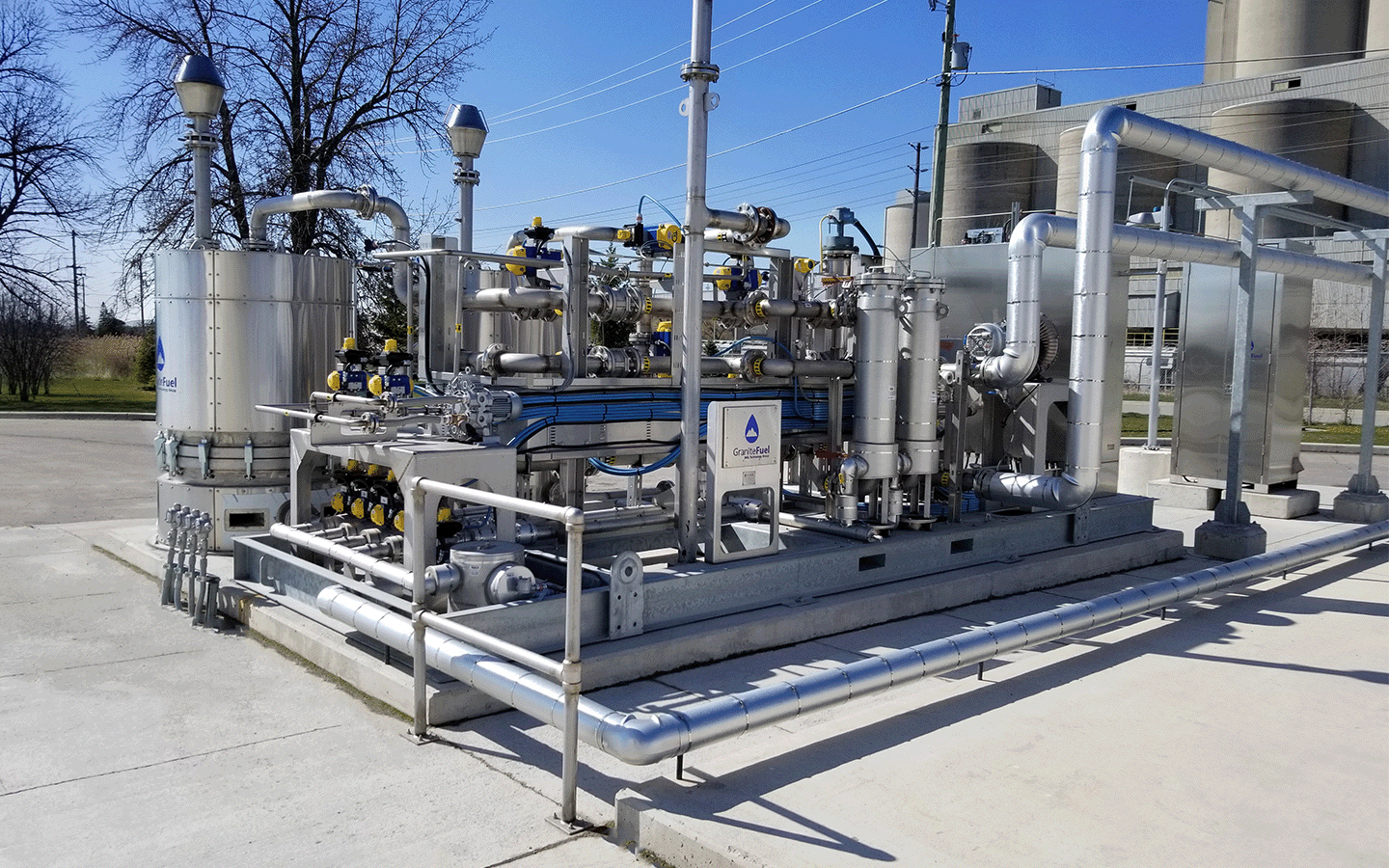
The GraniteFuel VOC and Siloxane Removal System provides high-efficiency removal of volatile organic compounds (VOCs) and siloxanes from biogas streams before upgrading. These trace contaminants can lead to serious issues such as membrane fouling, catalyst degradation, and silicon-based buildup in engines or turbines, all of which reduce efficiency and increase maintenance costs.
At the core of this system is GraniteFuel’s proprietary and patented Thermal Swing Adsorption (TSA) process, developed specifically for biogas applications. The TSA process enables efficient, in-place regeneration of adsorbent media through controlled heating and cooling cycles. This innovation achieves exceptional contaminant removal performance while minimizing energy use and extending media life, delivering a cost-effective solution for long-term operation.
Trusted in agricultural, municipal, and landfill gas applications, the VOC and Siloxane Removal System ensures consistently clean gas for renewable natural gas (RNG) upgrading, combined heat and power generation, and pipeline injection.
Key Features and Benefits of the VOC and Siloxane Removal System
Proprietary TSA technology for continuous operation
GraniteFuel’s patented Thermal Swing Adsorption process regenerates the adsorbent media automatically, allowing one bed to adsorb while another regenerates. This continuous cycling eliminates downtime, reduces operator involvement, and maintains steady gas quality.
High contaminant removal efficiency
The system captures a wide range of organosilicon compounds and volatile hydrocarbons that can damage upgrading membranes or combustion systems. Reliable VOC and siloxane removal helps maintain catalyst activity and ensures long-term equipment protection.
Energy-efficient design with optimized heat recovery
The TSA process uses precise thermal control and integrated heat recovery to minimize power demand during regeneration. This reduces operating cost and supports sustainable energy management across continuous biogas operations.
Long media life and low maintenance
Automatic regeneration extends adsorbent service life, reducing media replacement and waste generation. Operators benefit from lower operating costs and consistent removal efficiency throughout the media cycle.
Corrosion-resistant stainless-steel construction
All vessels, valves, and piping are built from stainless steel to withstand humidity, acidic gases, and temperature cycling typical in biogas environments. The durable design provides a long operating life with minimal maintenance.
Compact modular skid configuration
Each VOC and Siloxane Removal System is supplied as a fully integrated skid with adsorption vessels, blowers, heat exchangers, and control systems preassembled for rapid installation. The modular layout enables straightforward scaling for larger biogas or RNG facilities.
VOC and Siloxane Removal System Applications in Biogas and RNG Projects
Agricultural Biogas and Farm Digesters
Agricultural digesters often produce biogas with variable levels of volatile organics from diverse feedstocks. GraniteFuel’s VOC and Siloxane Removal System ensures a clean, consistent gas stream for upgrading or combustion, preventing catalyst fouling and reducing downstream service frequency.
Wastewater Treatment and Municipal Applications
Siloxanes are common in wastewater digester gas due to compounds found in personal care and cleaning products. The system efficiently removes these contaminants to protect CHP engines and catalytic equipment, extending uptime and maintaining compliance with gas-quality standards for RNG injection.
Landfill Gas Conditioning and Recovery
Landfill gas typically contains a complex mix of VOCs, siloxanes, and halogenated compounds that can quickly damage upgrading membranes. GraniteFuel’s TSA-based process maintains consistent contaminant control, supporting reliable operation and long-term system stability in landfill gas-to-energy applications.
Each system is engineered to the site’s gas composition and flow rate, ensuring high removal efficiency and continuous performance under all operating conditions.
Integration with Other GraniteFuel Systems
The VOC and Siloxane Removal System is typically positioned as the final step in the biogas conditioning sequence. It follows the NH₃ Removal System and operates in coordination with the Dehydration and H₂S Removal Systems to ensure complete gas cleanup prior to the Compression and Gas Separation Systems used for upgrading.
All GraniteFuel systems share compatible instrumentation and control logic, allowing centralized monitoring and coordinated process control across the conditioning and upgrading train. This integration ensures stable operation, improved efficiency, and simplified plant management.
Common VOC and Siloxane Removal Questions and Answers
GraniteFuel’s patented TSA process regenerates the adsorbent media through controlled heating and cooling cycles. This allows continuous contaminant removal without stopping production, minimizing media waste and reducing energy consumption compared to traditional adsorption systems.
VOCs and siloxanes can cause irreversible fouling of membranes, deactivate catalysts, and form abrasive silicon oxide deposits in engines and turbines. Removing these contaminants ensures reliable upgrading performance, protects downstream equipment, and maintains consistent RNG quality.
Yes. The system’s dual-bed TSA configuration allows one adsorption bed to regenerate while the other remains in service. Automated controls manage the thermal cycles and valve sequencing, providing uninterrupted contaminant removal in 24-hour biogas operations.
Contact GraniteFuel Engineering to learn how our patented TSA-based VOC and Siloxane Removal System can deliver high-efficiency contaminant control and cost-effective operation for your biogas or RNG upgrading project.