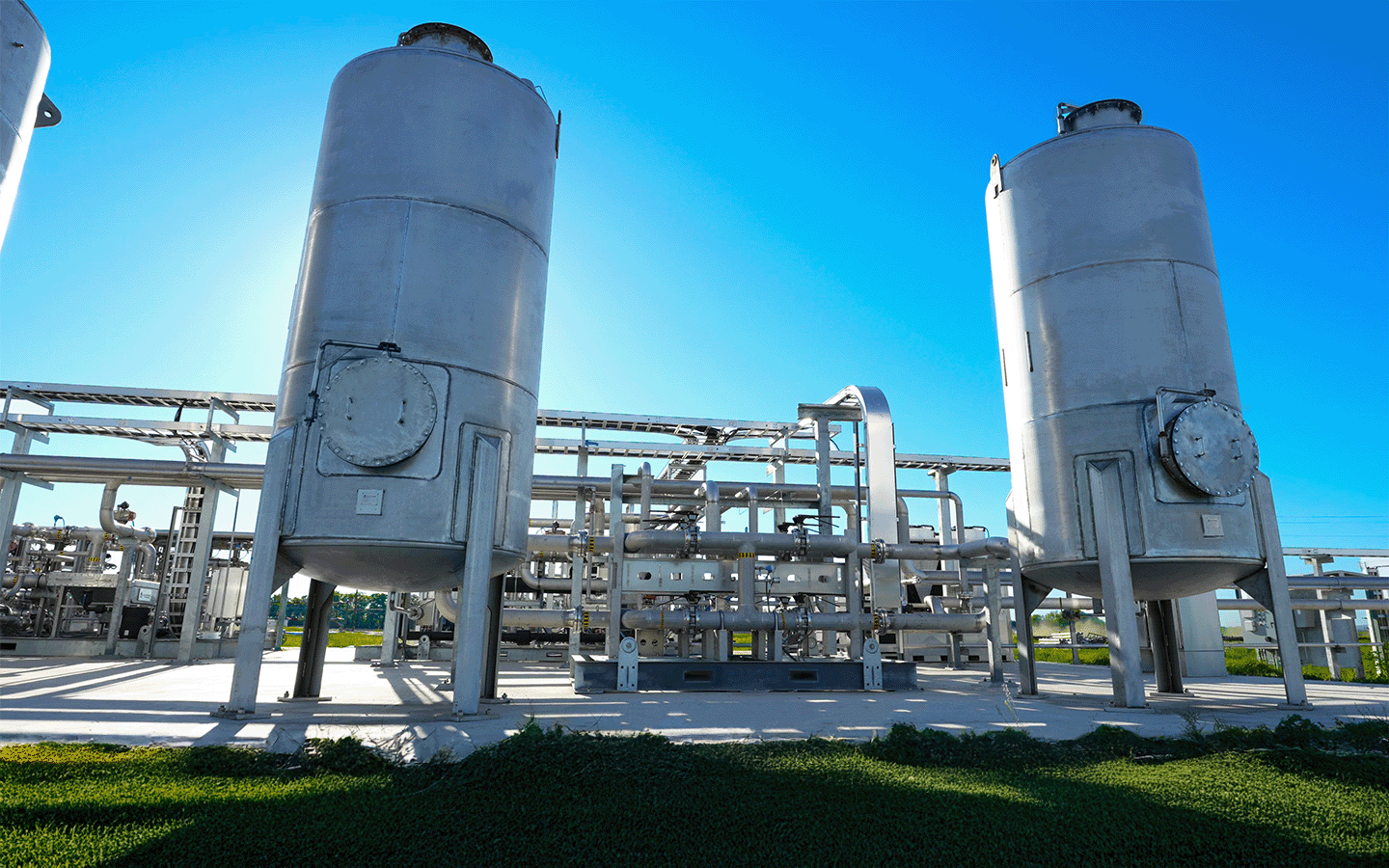
The GraniteFuel Activated Carbon Polishing System provides the final purification stage in the biogas-to-RNG upgrading process. After compression and membrane separation, trace contaminants may still remain in the gas stream, including low concentrations of hydrogen sulfide (H₂S), volatile organic compounds (VOCs), and residual siloxanes. The Activated Carbon Polishing System captures and removes these remaining impurities, ensuring the upgraded renewable natural gas (RNG) meets the most stringent pipeline and fueling specifications.
Developed as the final stage in GraniteFuel’s integrated conditioning and upgrading platform, the Activated Carbon Polishing System operates directly downstream of the Gas Separation System and Process Gas Compression System. Together, these systems produce clean, stable, and injection-ready RNG suitable for commercial energy distribution or on-site utilization.
Key Features and Benefits of the Activated Carbon Polishing System
High-efficiency contaminant removal
The system’s activated carbon media adsorbs trace hydrogen sulfide, volatile organics, and residual siloxanes that can impact gas odorization, combustion performance, and compliance with pipeline quality standards.
Optimized media performance and long service life
GraniteFuel selects premium activated carbon formulations designed for site-specific gas compositions. Each system is engineered with optimized flow distribution to maximize adsorption capacity and extend media life between changeouts.
Low pressure drop and consistent gas quality
The polishing vessels are designed to maintain stable flow with minimal pressure loss, preserving the efficiency achieved in upstream compression and separation systems. The result is a consistent, purified gas output that meets or exceeds specification for injection or fueling.
Simple operation and easy maintenance
This system operates continuously with minimal supervision. Media replacement is straightforward, and the system layout allows easy vessel access for service, reducing maintenance time and operational downtime.
Compact skid-mounted configuration
Each polishing system is delivered as a fully integrated skid with vessels, valves, and
controls preassembled for fast installation. The modular design allows flexible scaling for facilities of varying size or flow capacity.
System compatibility and integration
The Activated Carbon Polishing System is designed to operate immediately after the Gas Separation System and integrates seamlessly with GraniteFuel’s control infrastructure for unified monitoring and data management.
Activated Carbon Polishing System Applications in Biogas and RNG Projects
Agricultural Biogas and Farm Digesters
In agricultural RNG plants, the system ensures that the final gas meets strict pipeline and fuel-grade standards. It removes trace contaminants that may bypass the separation stage, protecting metering, storage, and injection systems from fouling or corrosion.
Wastewater Treatment and Municipal Facilities
Wastewater digester gas can retain trace VOCs and sulfur compounds even after separation. The Activated Carbon Polishing System guarantees odor-free, stable RNG output that meets utility and transportation fuel specifications while minimizing maintenance at injection points.
Landfill Gas Conditioning and Recovery
Landfill gas can vary significantly in trace compound concentrations depending on site conditions and feedstock. The Activated Carbon Polishing System stabilizes final gas purity by capturing residual contaminants, ensuring compatibility with downstream injection, storage, or fueling systems.
Each system is configured for the site’s flow rate, contaminant profile, and target gas purity to ensure reliable performance and optimized media utilization.
Integration with Other GraniteFuel Systems
The Activated Carbon Polishing System is positioned as the final purification step in GraniteFuel’s upgrading chain. It follows the Gas Separation System and receives pressurized gas from the Process Gas Compression System. Upstream, it is supported by VOC and Siloxane Removal, H₂S Removal, and NH₃ Removal Systems. Downstream, it connects directly to the injection or metering system for pipeline delivery.
All GraniteFuel systems share a common control and monitoring platform, allowing synchronized operation and centralized data logging across every stage of the conditioning and upgrading process.
Common Activated Carbon Polishing Questions and Answers
The system’s activated carbon media adsorbs trace hydrogen sulfide, volatile organics, and siloxanes that remain after compression and separation. This polishing step ensures the RNG meets or exceeds pipeline and fuel-quality standards.
Media life varies depending on contaminant concentration and flow rate. GraniteFuel engineers each system for optimal media performance, allowing extended service intervals and predictable changeout schedules for continuous operation.
Yes, in most cases. Even when upstream systems achieve high methane recovery, polishing ensures complete contaminant removal and compliance with gas-quality standards. It protects metering, injection, and combustion systems from residual trace compounds.
Contact GraniteFuel Engineering to learn how our Activated Carbon Polishing System can complete your biogas-to-RNG upgrading process with consistent, high-purity gas quality.